Traversée
Traversée is a game prototype developed in Unreal Engine 5 (Blueprints) during my training at Gaming Campus. It is a Tactical Survival Roguelite where players must cross multiple grid-based environments to complete the game. Weather is unforgiving, and the carried equipment is limited.
Role: Game Designer
Context: End of training prototype
Platform: PC
win condition
Cross all map biomes by completing each level of the game. The goal is to escape the planet the character crashed on.
failure state
If HP reaches 0, the character is teleported back to the crash site, and keeps backpack items for permanent crafting.
core loop
1/ Prepare
Fill limited backpack slots before starting a run.
2/ Navigate
Select the next level to enter on the world map.
3/ Survive
Adapt to dynamic weather hazards and other hostile elements.
4/ Level exit
Secure crafting resources after finishing a level.
design intent
The core intent was to create an experience where the player feels small and vulnerable against the game’s environment. The design relies on three pillars to achieve this:
Restricted mobility to keep a certain challenge during each level of the game.
Limited backpack space that forces constant trade-offs between short-term survival (bonuses) and long-term progression (crafting resources).
Weather and climate that act as antagonists and force a constant adaptation during a run.
Due to its punitive nature, the game targets midcore to hardcore players. They generally have a high tolerance for failure and appreciate trial and error loops. Runs are kept relatively short (roughly 30 minutes to complete all levels) and are tied to a meta-progression system to ensure players always feel rewarded after each attempt.

game board
Every level of the game is played in an isometric perspective where movement is restricted to an orthogonal grid (9x9 tiles). Every tile hosts specific interactions:
Creatures (capsules) are either static or move towards the player after they finished their turn. The creature’s movement has a fixed chance to happen (1/5). Combat resolves through a timing meter (sweet-spot mechanic). Success destroys the enemy; failure costs 1 HP and pushes the player back to the starting tile.
Moving triggers weather-based projectiles. Two of them were implemented for the prototype : random strikes under rain and sweeping lines under wind. If a projectile touches the player, they lose 1 HP. Weather patterns shift every 5 turns (randomly) and affected tiles are always shown to the player one turn in advance.
Players must navigate around traps (50% chance of costing 1 HP) to collect temporary bonuses.
survival constraints and trade-offs
Since the game relies on a few survival mechanics, some key elements of the game are intentionally restrictive:
The backpack starts with 8 slots total and 4 of them contain the starting equipment: Water and snacks for healing, a stove used as a weapon, and a tent that fully heals but costs 1 max HP and resets player position.
Bonuses and crafting resources all occupy inventory slots. A bonus takes a slot and its effect is activated as long as the player carries it. If the player wants to create space they have to throw away a bonus. Resources are only secured during a game over if carried in the backpack, forcing players to constantly weigh short-term survival against long-term progression.
Each level contains the same number of tiles, but environments become progressively more hostile (different climates that affect the player's HP, explained in the procedural level design section).
meta-progression
Each death sends the player back to the crash site with their carried resources where they can:
Craft new permanent equipment to get through extreme climates (arid and polar)
Upgrade some existing equipment (backpack’s capacity for example)
Choose their starting equipment before the next expedition

grid generation rules
The grid generation relies on strict rules to balance unpredictability:
The system always ensures a path to the exit is generated.
Player and resources spawn at fixed locations.
All tiles immediately adjacent to the player's spawn point are neutral.
Center row and center column never contain neutral tiles.
Each tile type has a fixed spawn probability.
Those rules adapt to the current climate. For instance, a Continental climate generates more traps, a Polar climate spawns more empty tiles, and an Arid climate generates more obstacles.

climate modifiers (biomes)
While weather is dynamic, the climate is fixed for the duration of a level. Players must strategically select their next level on the world map based on their current equipment:
Continental climate is found early in the run. Safe for health, those levels have a much lower chance of spawning rare resources.
Arid and Polar climates are mostly found in mid to end game. If the player has no specific equipment to withstand these climates, they passively lose 1 HP every 5 turns. However, these biomes have a significantly higher chance of yielding rare crafting resources.
Each level consists of individual tiles, with each type mapped to a specific material (distinct colors).
To build the playable grid, the procedural generation follows a strict sequence :
A loop generates a continuous array of indices based on the grid dimensions.
Procedural rules are applied to individual indices or groups of indices (rows, columns, specific areas)
Tiles are spawned at each index, respecting the defined conditions and probabilities.
Once the grid is established, the system instantiates the remaining actors:
The main character
The exit resource
Traps and creatures on the red tiles
Bonuses on the green tiles
Finally, the dynamic weather manager is initialized.
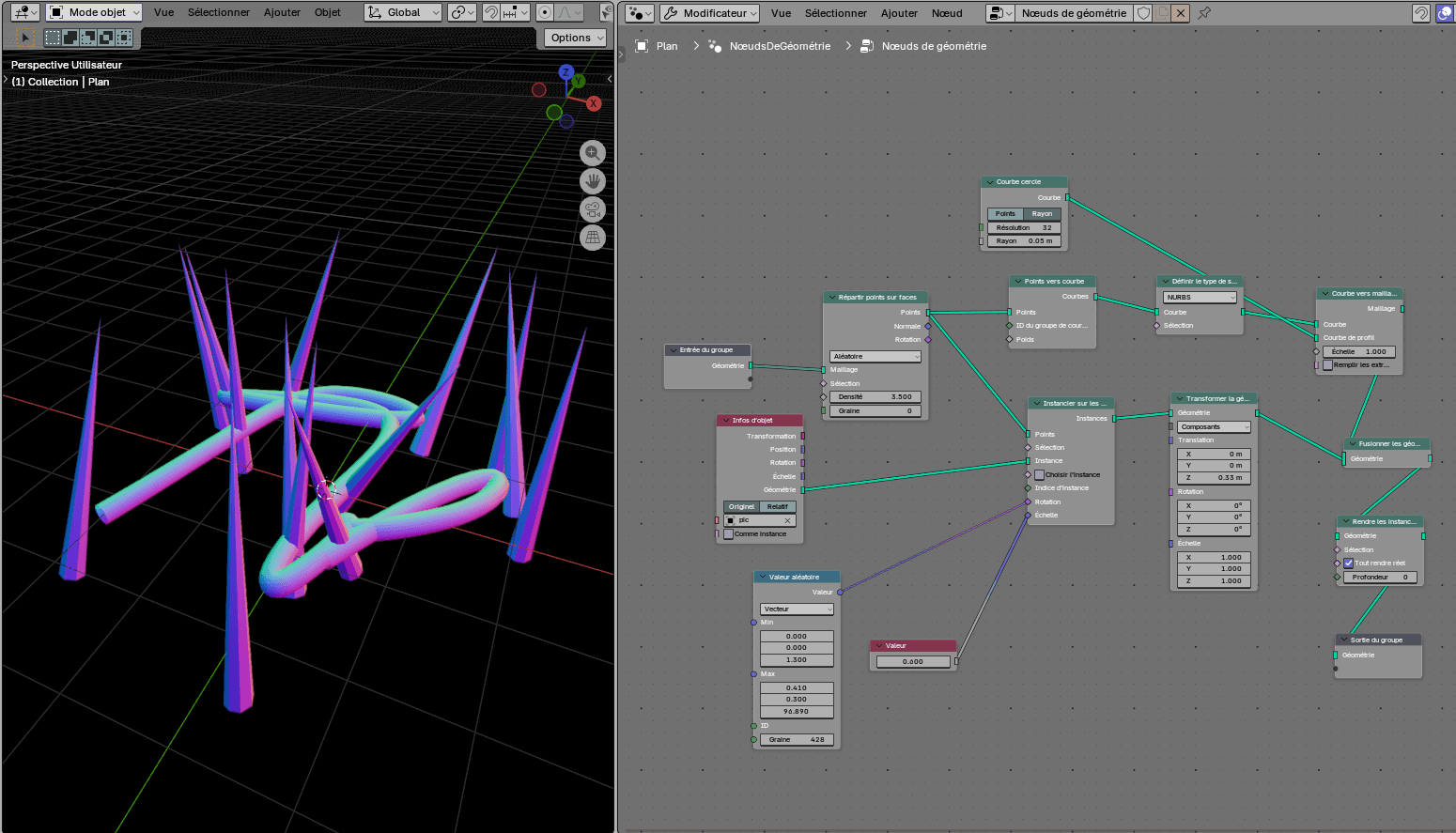
The first Blueprint graph below demonstrates the grid setup and actor placement pipeline.
The second Blueprint graph demonstrates the weather setup and its associated VFX.


Key wins: Trusting in-engine tests more than written mechanics.
The training started with the writing of a GDD that provided a solid baseline for prototyping, but testing reshaped some core interactions. The prototype evolved significantly beyond the initial document: For instance, grid and inventory dimensions were resized multiple times, weather effects were redesigned to feel more impactful, and there was even a weight mechanic that impacted combat and movement, but was scrapped because it felt unnatural on a grid system. It reinforced a well-known concept in game design: Prototyping early in-engine remains the best validator for game design logic.
The challenges: Code architecture and balance
To expand this prototype into a full release, the primary focus would be long-term player retention and avoiding repetitiveness. Content matters, but variations are way more important.
The Blueprint architecture in UE5 lacked cleanliness and scalability and it was difficult to see how I could scale this project without remaking a major part of the architecture. This point is one of the reasons why Versatree exists.
The game can be really frustrating (many constraints on the player and RNG dependencies) and there are no moments that were designed to give the player any breathing room. Even for the targeted type of players it can be daunting. Strengthening bonuses could solve this friction and it could have a double benefit:
More powerful rewards reinforce the dilemma between short-term survival and long-term progression, forcing players to sacrifice a powerful active perk whenever they want to extract rare crafting resources.
They also naturally balance the game's difficulty and reduce frustration for the player.